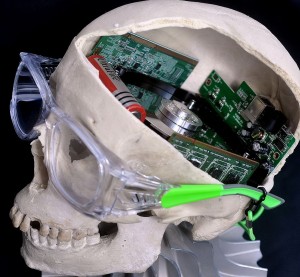
© Dr Michel Royon / Wikimedia Commons
The deluge of information in modern times by the media and other information sources has led to daily “bombing” of the average human brain with such a large volume of information which could overload even a powerful computer, according to a new U.S. scientific research.
The study, conducted by researchers at the University of California-San Diego, under Roger Bon, according to the British “Times of London” and “Telegraph”, believes that people are every day inundated with the equivalent amount of 34 Gb (gigabytes) of information, a sufficient quantity to overload a laptop within a week.
This study has been conducted a few years ago so we are sure this number is much bigger in 2023 and later.
Through mobile phones, online entertainment services, the Internet, electronic mail, television, radio, newspapers, books, social media etc. people receive every day about 105,000 words or 23 words per second in half a day (12 hours) (during awake hours).
Although people can not really read these 105,000 words each day, this is the real number estimated to be reaching the human eyes and ears every day. After adding pictures, videos, games, etc., we reach the volume of 34 Gigabytes of information per day on average.
The total consumption of information from television, computers and other information was estimated (for the U.S.) to be 3.6 million gigabytes.
Traditional media (TV and radio) continue to dominate the daily flow of information with about 60% of hours’ consumption.
The study considers that our brains are not directly threatened, but does not exclude a detrimental effect or information “flood” which might lead to different development path of the human brain by creating new neural connections, given that our brain has now shown that it is “malleable” and can be “wired” each time differently, depending on the quantity and quality of the stimuli it receives.
According to the researchers, the main effect of information overload is that the human attention to focus is continually hampered and interrupted all too often, which does not help in the process of reflection and deeper thinking.
As commented by the American psychiatrist Edward Hallowell, “never in human history, our brains had to work so much information as today. We have now a generation of people who spend many hours in front of a computer monitor or a cell phone and who are so busy in processing the information received from all directions, so they lose the ability to think and feel. Most of this information is superficial. People are sacrificing the depth and feeling and cut off from other people.”
In a more hopeful manner, neuroscientist and professor of physiology at Oxford University, UK John Stein, stressed that in the Middle Ages, when printing was invented, people were concerned that the human mind would not withstand a lot of information, which however was not true at the end.
Roger Bohn and James Short, who did the actual research, explained that the study did not record how much information from these daily 34 gigabytes eventually is absorbed by the brain.
On the other hand, they pointed out that what has changed in modern times is mainly the nature of the information received, rather than its quantity. As they said, looking at either a computer screen or talking face to face with someone, in fact our brain can absorb the same amount of information.
A face to face conversation has its own equivalent of bytes of information (not known how much), since the brain monitors the expressions of other people, listens to the tones of their voice, etc.
According to the assessment of Bohn and Short, if such a face to face conversation causes our brain to store information with rate of 100 megabits per second, then a two-hour conversation with someone will store even more information than the estimated volume of electronic information received within a day in our brain.
How much information can the brain store?
So a question naturally comes to mind: If our brain is loaded with so much information every day, will it get full after some years? Paul Reber, professor of psychology at Northwestern University, states that our brain will certainly not get full in our lifetime.
As Reber explains in www.scientificamerican.com, we have close to 1 billion neurons in our brain, with each neuron forming connections to other neurons and being capable to hold many memories at a time.
So, he estimates that our brain’s memory storage capacity is around 2.5 Petabytes. This is a huge memory capacity that can hold an estimated number of 3 million hours of TV shows. So don’t worry about it, our brain’s capacity is big enough to handle all this information overload successfully!!

Hy there,
in your article there is, in my own opinion, a substantial confusion in WHAT our brain does and Where the informations are STORED. From my readings in the matter it has been exactly determined the ONLY function of our brain is to PROCESS the info and re-direct them to the proper part , area, of the human body that are stored into the DNA of the cells (all cells, part of them? I don’t know). Is this correct? In short, the brain processes and the DNA stores. So, the picture of Dr. Michel Royon , Wikimedia Common is misleading because the skull contains a Hard Disk Drive; and the memory in the humans / animals are sprayed throughout the body.
What’s your opinion?
Rick Balbusso
Indonesia
Rick,
I haven’t studied the subject in depth. I’m just presenting some scientific findings.
This website definitely has all of the information I needed about this subject and didn’t know who to ask.
This is terrific. Nowadays, we get so many information into our mind. some of it we don’t want others will just make a barrier for learning what we want to learn. The findings will be much better if it was mixed with NLP and Psychological studies will get much better results. we are aware of the effect of exposing humans to pictures of certain objects in microseconds can have a tremendous of effect on judgement and I believe the type of information that we get everyday has a great impact on our brain, behavior and judgement. The findings are not secret!!! it’s just a new angle on measuring the information we receive which is quite interesting.
If Reber is close in estimating our brain’s memory storage capacity is around 2.5 Petabytes, I figure that, if we’re storing 34 GB/day, we’d have to live 6,849.315 years to reach capacity.
But that’s *storing* information. What about how much information we can *functionally process* every hour (that is, to make sense of all the information and *organize* it in some useful way)?
When we dream, some of us notice that we dream fragments of what we experience day to day being mixed with previous experiences. And on top of that our mind/brain generates projections of our *potential* experiences to help us be prepared to act instantly for any contingency. And on top of that, we dream fantasies that pit our social conditioning against our unfettered desires. And then we can be processing all of that *simultaneously* -with every one of those processes responding to each other, generating all manner of new information from the synthesis of it all.
So we can see from this simple observation how every byte of information we take in *compounds* all previous information to potentially unlimited degrees. How can we *account*for the storage of all of *that* plus our brain/mind’s notes, drafts and the various mosaics of memories, thoughts, feelings, projections, notes, etc. that it’s piecing together at different rates, each at various stages of “completion” (which most of them never really become “complete” given the infinite possibilities the brain/mind can apprehend and anticipate!
Again, that’s just the storage part of the question here. The other part of the question is how much information can we actually *process* (not just store) in every second?
And, how much *internal* (biological) information are we processing every second? Has that been quantified and considered against everything our brain is taking in from our *external* environment?
105,000 words or 23 words per second in half a day (12 hours) ??? 23x60x60x12=993600…ups
Hey James, you missed something
2.5 Petabytes = 2,500,000 Gbs
2,500,000/34 = 73,529.4 days = 201.4 years
But you directly divided 2,500,000 by 365 (=6,849.315)
Hope you’ll consider but don’t mind.
Thanks
Hey Saleem,
It would be great to have 34 hours in a day! Great math!
Hello everyone, What do you have to say about number of hours we actually do not use our brain i.e. while brushing, while wearing shirt etc. in a day. I do not mean that during these activities our brian do not work. I only want you to throw some light on Consciously usuage of brain and casual usuage of brain.
The referred article is available at: https://ijoc.org/index.php/ijoc/article/viewFile/1566/743
Finding it took a couple of steps as the name of the authors is misspelled in the blog post. They are Roger Bohn and James Short.
Thanks for pointing out the typo mistake. Just corrected the names in the article.